
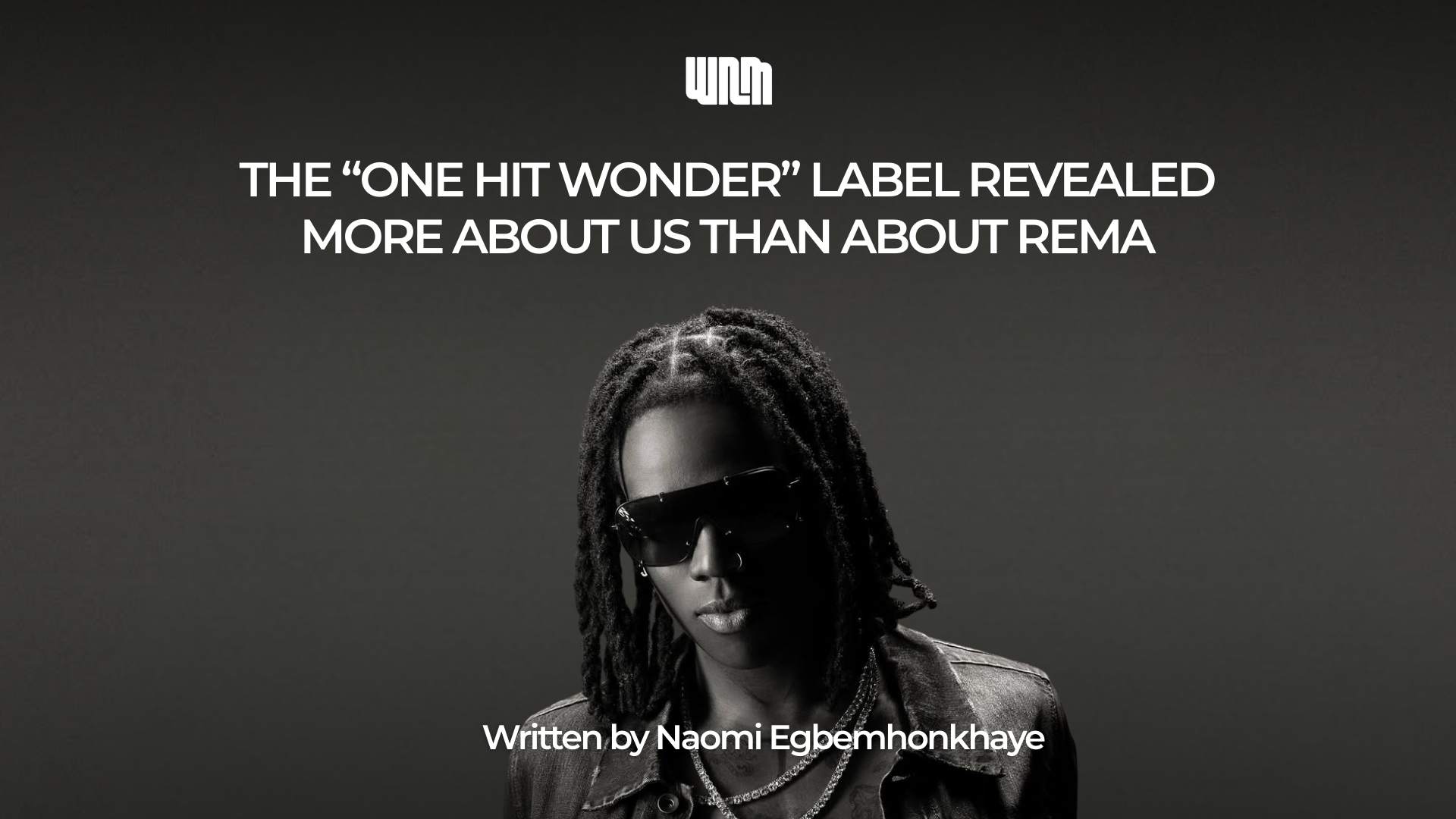
By Naomi Egbemhonkhaye
February 25, 2026
When Billboard described Rema as a “one-hit wonder,” the internet reacted exactly how you’d expect. Nigerians were irritated, Africans were defensive, and timelines were loud. And honestly, the irritation made sense.
How do you reduce an artist with sold-out global tours, international collaborations, and one of the most streamed Afrobeats records in history to a single statistical moment?
But here’s the uncomfortable truth: Billboard didn’t insult Rema. Billboard followed its metrics, and that distinction matters.
Rema’s “Calm Down” didn’t just chart; it became a cultural crossover record. It peaked high on the U.S. Hot 100 and stayed long enough to shift global perception about Afrobeats. But because he hasn’t yet replicated that exact performance on that specific American chart, the technical classification was applied; cold, clinical, and metric-driven.
The real issue isn’t Billboard doing what Billboard does. The issue is that the global music hierarchy still runs on American-centred validation systems, and we continue to measure ourselves against them.
This conversation is bigger than Rema.
Across much of Africa, Afrobeats thrives culturally but struggles institutionally. We lack unified charting systems with global authority. We lack consistent documentation and structured archives. Even the genre itself is still debated and inconsistently categorised depending on who is framing it.
Some regions of South Africa, for example, have stronger formal systems. But across the continent, the industry still operates largely on momentum, virality, and community impact rather than structured infrastructure. And when conversations shift into rooms where structure matters, we find ourselves reactive instead of prepared.
There is also a journalism gap we rarely address. Afrobeats is one of the most globally influential genres right now, yet there is a shortage of rigorous, analytical criticism documenting its evolution. Not fan threads. Not outrage cycles. Not reactive posts. But sustained cultural writing that builds context, archives movements, and challenges narratives in real time.
When the “one-hit wonder” label surfaced, there weren’t enough immediate, well-researched counter-arguments grounded in documented data and historical framing. That silence wasn’t because the case didn’t exist, it’s because we haven’t invested enough in the institutions that would make it visible.
And investment is the real conversation.
Media houses operate within tight financial ecosystems. Critics need funding. Archives require maintenance. Charting bodies need credibility. Data infrastructure needs scale. Without sustained capital, growth remains fragile and narratives remain externally shaped.
We cannot demand global authority while neglecting local systems.
Until we build stronger institutions around Afrobeats, data tracking, journalism, archiving, criticism, and charting, we will continue to celebrate viral moments without securing lasting structural power.
The “one-hit wonder” label doesn’t define Rema’s career. It exposes the imbalance between cultural dominance and institutional recognition.
And here’s the part we should really sit with: if our success can only be validated through someone else’s system, then the real work isn’t arguing headlines, it’s building our own tables.
Because cultural power without institutional power will always feel temporary.
And Afrobeats are no longer temporary.
By signing up to the WNM monthly newsletter you agree to receive electronic communications from WNM that may sometimes include advertisements or sponsored content.